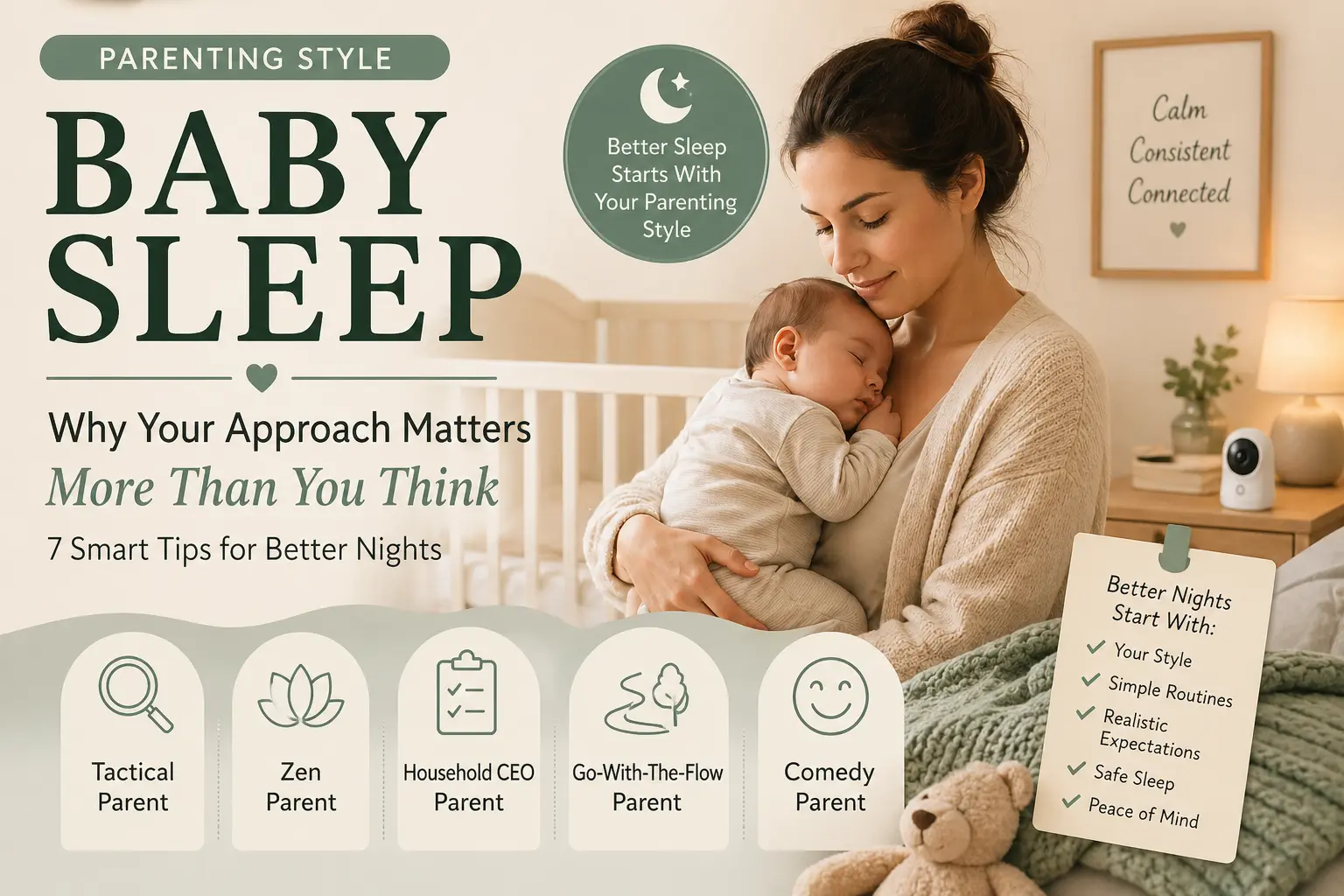
Parenting Style Baby Sleep: Why Your Approach Matters More Than You Think
Every new parent wants sleep — but parenting style baby sleep is often more complicated than it looks.
Not “perfect sleep.”
Not “Instagram nursery sleep.”
Just a few decent hours where nobody is crying, the monitor is quiet, and you are not Googling why does my baby only sleep when I’m standing up at 2:47 a.m.
Baby sleep has a way of humbling everyone.
You can read every sleep guide, buy the softest pajamas, set up the coziest nursery, and still end up walking around the living room in socks, whispering, “Please, just twenty more minutes.”
But here is the part many sleep articles miss:
Baby sleep is not just about your baby.
It is also about how you respond as a parent.
Your parenting style affects how you handle bedtime, crying, routines, wake-ups, sleep advice, baby monitors, and all those tiny decisions that somehow feel huge when you are exhausted.
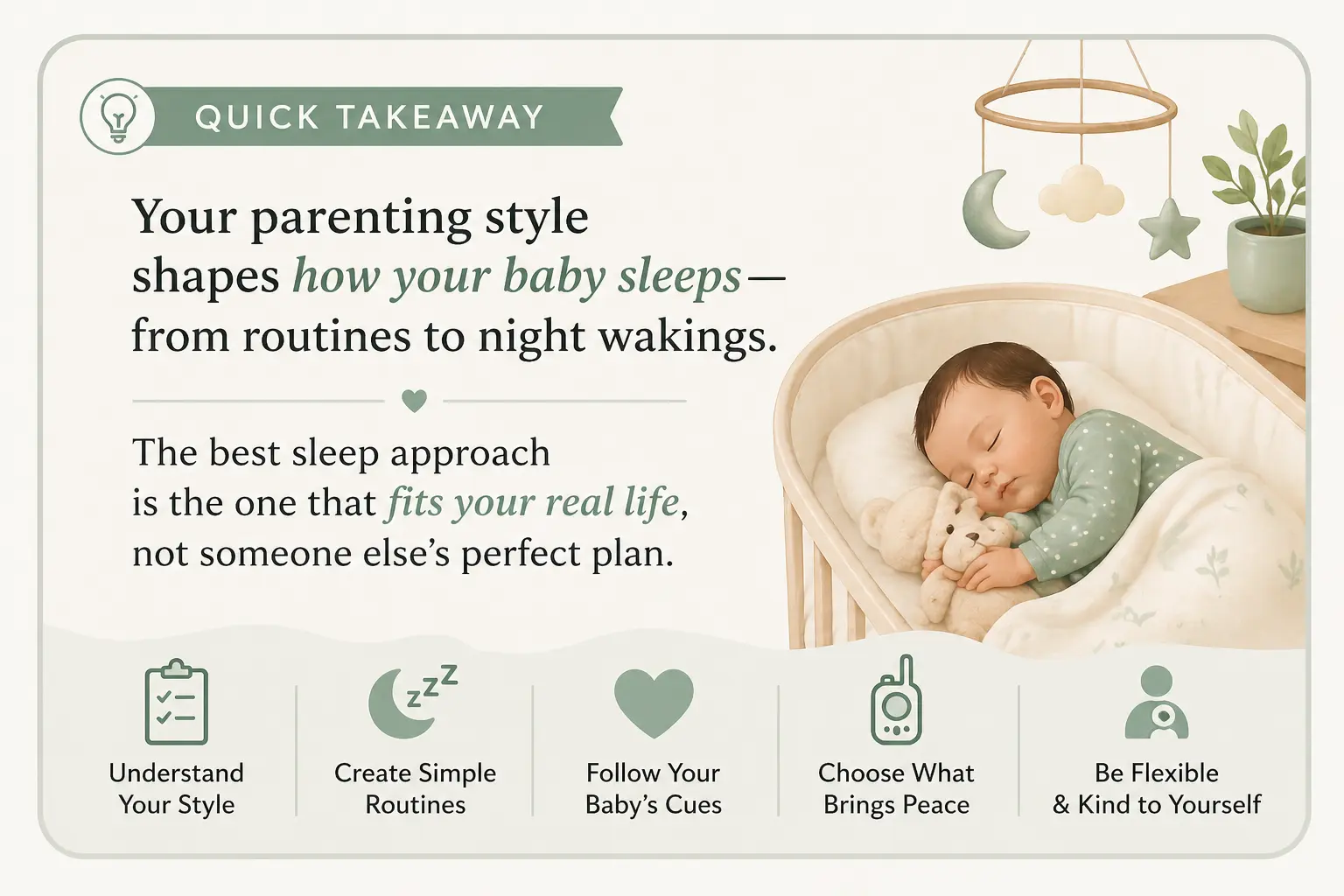
That is why understanding your parenting style baby sleep pattern can help you build a sleep approach that fits your real family life — not someone else’s perfect schedule.
Why Parenting Style Baby Sleep Matters
Understanding parenting style baby sleep can help you avoid following advice that sounds good online but doesn’t actually fit your real life.
Most baby sleep advice sounds simple until you try to follow it.
One person says to create a strict bedtime routine.
Another says to follow your baby’s cues.
One expert talks about wake windows.
Another parent tells you their baby slept through the night because they “just stayed consistent,” which is not nearly as helpful as they think it is.
The truth is, different parents need different sleep strategies.
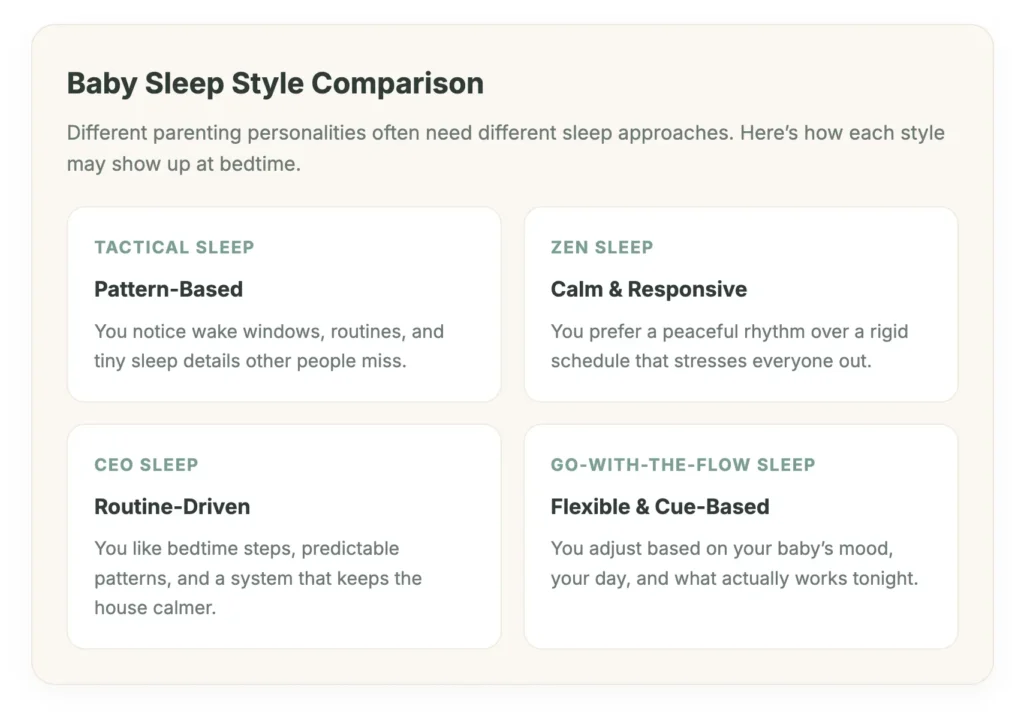
A Tactical Parent may want a plan.
A Zen Parent may want calm and flexibility.
A Household CEO may want a repeatable routine.
A Go-With-The-Flow Parent may want room to adjust.
A Comedy Parent may just want to survive the 3 a.m. chaos with a little dignity.
None of these parents are wrong.
They simply approach baby sleep differently.
If you are still learning how your personality affects your parenting choices, start with our guide on what your parenting style means.
Baby Sleep Is Emotional, Not Just Practical
On paper, baby sleep looks like a schedule problem.
In real life, it feels personal.
When your baby will not sleep, it can make you question everything:
- Are they hungry?
- Are they overtired?
- Did we miss the wake window?
- Is the room too bright?
- Are we creating bad habits?
- Why does everyone else’s baby seem easier?
That last one is dangerous.
Because when you are tired, comparison hits harder.
You see another parent online talking about a perfect bedtime routine, and suddenly your normal, messy night feels like failure.
But it is not failure.
It is newborn life.
Your baby is learning.
You are learning.
And your parenting style is shaping the way you respond.
- ☐ I feel better when I have a clear bedtime routine
- ☐ I prefer to follow my baby’s cues instead of a strict schedule
- ☐ I track naps, feeds, or wake windows
- ☐ I get anxious when sleep doesn’t go as planned
- ☐ I need flexibility to stay calm during rough nights
Tactical Parent: The Sleep Researcher
If you are a Tactical Parent, baby sleep can quickly become a research project.
You may read about wake windows, nap transitions, bedtime routines, feeding patterns, sleep regressions, and whether your baby is “supposed” to be doing something by a certain age.
You probably like information because information makes you feel prepared.
That is a strength.
Tactical Parents are often good at noticing patterns. You may realize your baby sleeps better after a certain bedtime, gets fussy after too much stimulation, or needs a calmer wind-down routine.
For many families, parenting style baby sleep becomes a balance between research and real-life flexibility.
But the challenge is this:
Baby sleep is not always logical.
Sometimes your baby has a short nap for no clear reason.
Sometimes they wake up even when you did everything “right.”
Sometimes the plan works beautifully on Tuesday and completely falls apart on Wednesday.
That does not mean you failed.
It means you are parenting a baby, not programming a microwave.
Strength: You notice patterns and prepare well.
Watch out for: Turning every bad night into a problem to solve.
If your Tactical side also shows up in baby gear choices, you may enjoy The Tactical Parent Guide.
Zen Parent: The Calm Sleeper
Zen Parents often bring a peaceful energy to sleep.
You may not want to track every minute or follow a rigid schedule. You might prefer to respond naturally, keep things simple, and trust that your baby will find a rhythm over time.
This can be beautiful.
A calm parent can make bedtime feel softer and less tense. Babies do not need parents who are perfect, but they do benefit from parents who are emotionally steady.
Still, even Zen Parents sometimes need a little structure.
A calm approach works best when it has a few simple anchors:
- A safe sleep space
- A gentle bedtime rhythm
- A familiar wind-down pattern
- A realistic expectation for night waking
Zen does not mean “we have no plan.”
Zen means “we have a plan that does not destroy our peace.”
Strength: You reduce stress around sleep.
Watch out for: Avoiding helpful routines because they feel too strict.
If this sounds like you, read The Zen Parent Guide for a deeper look at calm, flexible parenting.
Household CEO: The Routine Builder
Household CEO parents often feel most comfortable when the day has a system.
And honestly, baby sleep is one area where systems can help.
You may want a bedtime routine, a nap rhythm, a feeding pattern, and a predictable sleep environment. You might like knowing what comes next because it helps the whole household feel less chaotic.
This can be incredibly useful.
A simple routine can help babies recognize sleep cues over time. Bath, pajamas, feeding, dim lights, white noise, sleep space — the order can become familiar and comforting.
But here is the catch:
Babies are not employees.
They do not care that the schedule says nap time starts at 9:15.
Some days will not cooperate. Growth spurts, teething, travel, illness, and random baby weirdness can all interrupt even the best routine.
Strength: You create consistency.
Watch out for: Feeling frustrated when real life breaks the plan.
A good Household CEO sleep approach is structured, but not brittle.
Go-With-The-Flow Parent: The Adaptive Sleeper
Go-With-The-Flow Parents usually do not want sleep to feel like a military operation.
You may prefer to adjust based on the day. If the baby is tired, you help them sleep. If the nap is short, you move on. If bedtime shifts, you do not panic.
This flexibility can protect your mental health.
Some parents become so stressed about perfect sleep that they lose the ability to respond to the baby in front of them. Go-With-The-Flow Parents are often better at accepting imperfect days.
The challenge is that too much flexibility can make patterns harder to build.
Your baby may benefit from a few predictable cues, even if you do not want a strict schedule.
Think of it this way:
You do not need a rigid routine.
You need a rhythm.
Strength: You adapt well.
Watch out for: Letting every day become completely different.
If daily rhythm has been hard to build, you may like our guide on parenting style and daily routine.
Outdoor Explorer: The On-the-Go Sleeper
Outdoor Explorer Parents often want baby sleep to fit into real life.
You may imagine walks around the neighborhood, stroller naps, car rides, family visits, errands, parks, and maybe even a coffee run that feels like a small vacation.
This style is very common in the U.S., especially for parents who do not want to feel trapped inside all day.
A little fresh air can be good for everyone.
But babies vary.
Some babies nap beautifully in a stroller or carrier. Others need a quieter room and a familiar setup. Some can sleep through the sound of a coffee shop. Others wake up if a floorboard thinks about creaking.
Your job is not to force your baby into your ideal lifestyle immediately.
It is to find a balance.
You can still be an active, outside-the-house parent. Just pay attention to how much stimulation your baby can actually handle.
Strength: You keep life moving.
Watch out for: Overstimulation and missed rest cues.
For outings, gear can matter. A practical stroller or comfortable carrier can make the difference between “nice walk” and “why did we attempt this?” You can compare options in our guides to best baby strollers for everyday parents and best baby carriers for new parents.
Comedy Parent: The Sleep Survivor
Comedy Parents understand the truth:
Baby sleep is sometimes ridiculous.
You can do the exact same bedtime routine two nights in a row and get two completely different results. One night your baby sleeps peacefully. The next night they act like the crib personally offended them.
Comedy Parents survive by keeping perspective.
You may use humor to handle the absurdity of sleep deprivation, weird noises, failed naps, and the emotional drama of finally sitting down only to hear the baby wake up.
This does not mean you do not care.
It means you know that laughing sometimes keeps you from crying.
That is a real parenting tool.
Just make sure humor does not replace problem-solving when something truly needs attention.
Strength: You protect your emotional energy.
Watch out for: Brushing off patterns that could be improved.
Sleep Setup: Where Parenting Style Shows Up Fast
This is where parenting style baby sleep shows up clearly — in the choices you make for your baby’s sleep environment.
Your sleep setup says a lot about your parenting style.
A Tactical Parent may compare every safety feature.
A Zen Parent may want the simplest safe option.
A Household CEO may think about room layout and nighttime flow.
A Go-With-The-Flow Parent may start basic and adjust later.
One of the first choices many families face is whether to use a crib or bassinet.
That decision depends on space, nighttime feeding, budget, comfort level, and how you imagine those early weeks working at home.
If you are still deciding, our guide on crib vs bassinet can help you compare both options without overcomplicating it.
Baby Monitors and Sleep Anxiety
Baby monitors are another place where parenting style matters.
Some parents feel calmer with a video monitor because they can see the baby.
Others feel more anxious because they keep checking the screen every few minutes.
A Tactical Parent may compare camera quality and features.
A Zen Parent may prefer fewer alerts.
A Household CEO may want monitoring built into the bedtime system.
There is no one right answer.
The best monitor is the one that gives you helpful peace of mind — not constant anxiety.
If you are deciding what fits your home, read our comparison of video baby monitor vs audio baby monitor.
How to Build a Sleep Approach That Fits Your Style
You do not need to copy someone else’s sleep method.
Start with your parenting style and build from there.
1. Choose one simple anchor
This could be dim lights, a short bedtime routine, a sound machine, or the same sleep space.
Small consistency matters.
2. Keep expectations realistic
Newborn sleep is not linear.
Good nights and bad nights can both be normal.
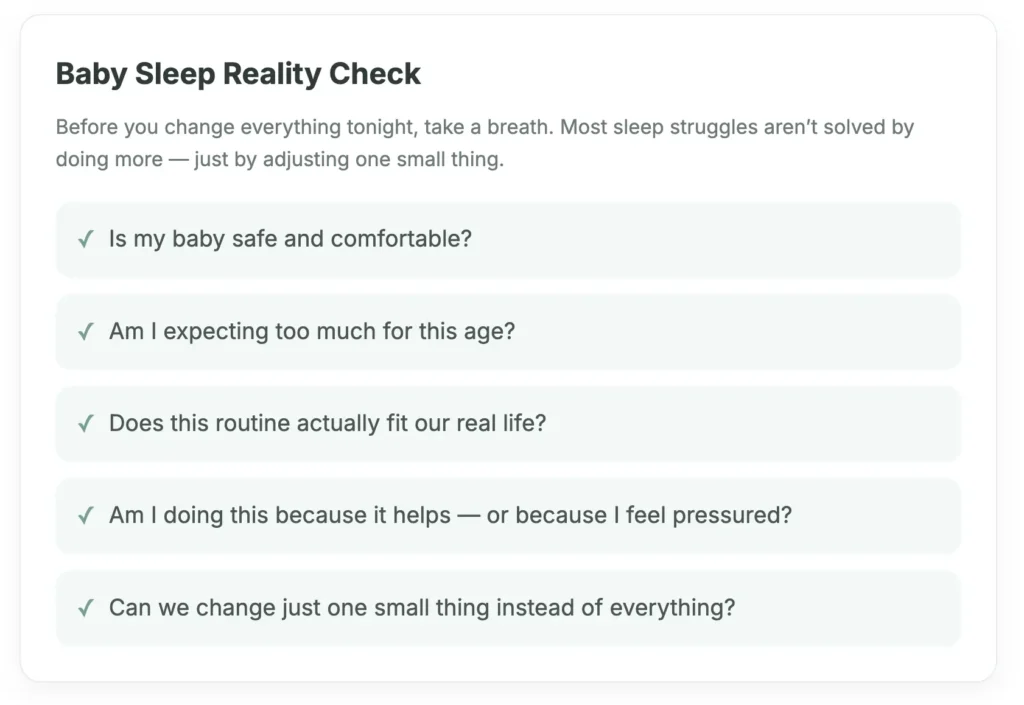
3. Avoid changing everything at once
When sleep is hard, it is tempting to overhaul the whole system.
Try one small change first.
4. Notice your own stress pattern
Are you over-researching?
Avoiding structure?
Trying to control everything?
Laughing it off too much?
Your reaction matters too.
5. Make safety non-negotiable
No matter your style, safe sleep comes first.
For external guidance, you can review AAP safe sleep recommendations when setting up your baby’s sleep space.
Not Sure What Your Parenting Style Is?
If baby sleep has made you feel like five different parents in one week, you are not alone.
You might be Tactical when reading sleep advice, Zen when soothing your baby, Household CEO when setting up bedtime, and Comedy Parent by 4 a.m.
That is real life.
Most parents are a mix.
But usually, one pattern stands out.
A quick parenting style quiz can help you understand your natural approach in about 60 seconds.
It will not magically make your baby sleep through the night.
But it can help you understand why certain sleep strategies feel natural — and others make you want to throw the schedule into the diaper pail.
Final Thoughts
Baby sleep is not just about methods.
It is about fit.
The best sleep approach is the one that keeps your baby safe, supports your family, and feels realistic enough to repeat.
That is the heart of parenting style baby sleep: finding a rhythm that fits your baby, your home, and your real life.
Some parents need structure.
Some need flexibility.
Some need calm.
Some need a checklist.
Most need a little of everything.
Once you understand your parenting style, sleep advice becomes easier to filter.
You stop chasing every method.
You start building something that actually works for your baby, your home, and your sanity.
And honestly, that is the kind of sleep plan parents can actually live with.
Suggested Reading
- What Is My Parenting Style?
- The Zen Parent Guide
- Parenting Style and Daily Routine
- Best Parenting Style for Newborns
- Parenting Style and Baby Crying
- Crib vs Bassinet
- Video Baby Monitor vs Audio Baby Monitor
In the end, parenting style baby sleep is not about perfection — it’s about finding what actually works for your family.