Parenting Style Examples: 7 Real-Life Moments That Actually Work
Parenting style examples are easier to understand when they sound like real life.
Not textbook definitions.
Not perfect-family social media posts.
Real life.
Like choosing a stroller at midnight.
Trying to calm a crying baby while your coffee gets cold.
Packing a diaper bag like you are either going to Target or crossing the Appalachian Trail.
Wondering if you are too strict, too relaxed, too anxious, or somehow all three before lunch.
Most parents do not wake up thinking, “Today I will practice my parenting style.”
But your style shows up anyway.
It shows up in how you make decisions, how you handle stress, how much you plan, how flexible you are, and how you respond when the baby does something completely normal but deeply inconvenient.
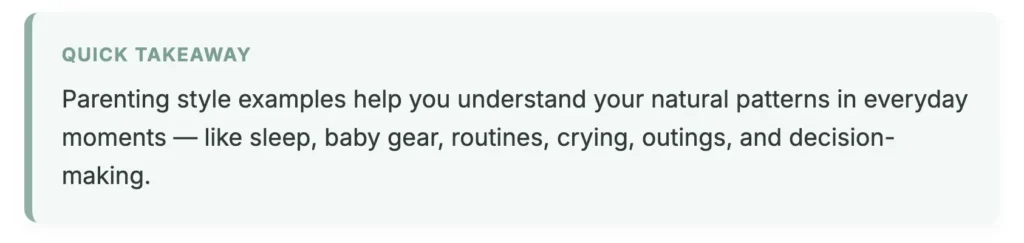
That is why real-life parenting style examples can be so helpful.
They show you who you are when parenting gets practical.
Why Parenting Style Examples Matter
Most parenting style articles explain categories.
They tell you about authoritative, authoritarian, permissive, and uninvolved parenting.
Those ideas can be useful, but new parents usually need something more practical.
Because when your baby is crying, you are probably not thinking:
“Which parenting framework am I demonstrating right now?”
You are thinking:
“Is this hunger? Gas? Sleep? A diaper? Why is the pacifier suddenly offensive?”
Real-life examples help because they connect parenting style to actual daily decisions.
Your style may affect:
- How you respond when your baby cries
- How much baby gear research you do
- How you build routines
- How you handle sleep
- How you pack for outings
- How you respond to advice
- How confident you feel after making decisions
If you are still learning the basics, start with What Is My Parenting Style?.
Parenting Style Example 1: Choosing Baby Gear
Baby gear is one of the clearest places your parenting style shows up.
Let’s say you are choosing a stroller.
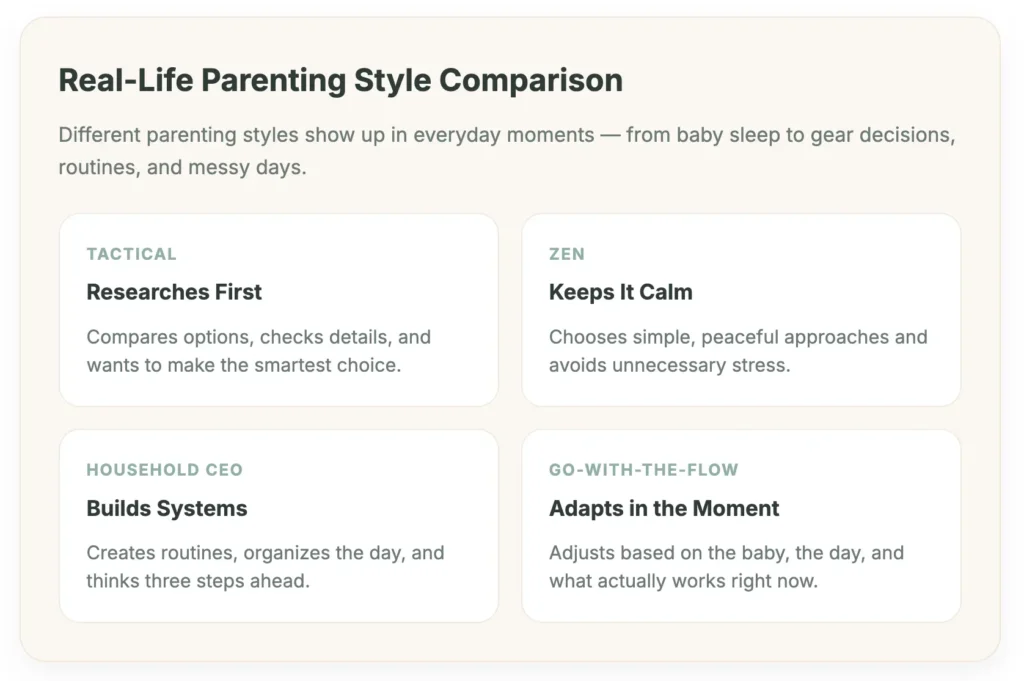
A Tactical Parent may open fifteen tabs, compare features, check reviews, read safety notes, and make a small spreadsheet that no one asked for but everyone benefits from.
A Zen Parent may want something simple, easy to fold, and not stressful to use.
A Household CEO may think about storage, car trunk space, errands, daily routines, and whether the stroller fits the family system.
A Go-With-The-Flow Parent may choose something practical and adjust later if needed.
An Outdoor Explorer may care most about sidewalks, parks, walks, and whether the stroller can handle real life outside the house.
A Comedy Parent may say, “If it rolls and the baby tolerates it, we’re doing great.”
None of these approaches are wrong.
They simply show different decision-making patterns.
If stroller decisions are on your list, this guide to best baby strollers for everyday parents can help you compare practical options without getting lost in endless choices.
- ☐ I compare reviews, features, and safety details before choosing
- ☐ I prefer simple products that don’t add more stress
- ☐ I think about how everything fits into our daily routine
- ☐ I buy the basics first and figure out the rest later
- ☐ I care most about getting out of the house easily
Parenting Style Example 2: Responding When Your Baby Cries
A crying baby can reveal your parenting style very quickly.
A Tactical Parent may start troubleshooting:
Hungry?
Diaper?
Gas?
Too hot?
Too cold?
Overtired?
A Zen Parent may take a breath, hold the baby close, and respond calmly without immediately spiraling.
A Household CEO may think about timing: “They ate 90 minutes ago, skipped the last nap, and usually get fussy around now.”
A Go-With-The-Flow Parent may try one thing, then another, and adjust in the moment.
A Comedy Parent may gently bounce the baby and whisper, “I agree, this day has been a lot.”
Different styles. Same goal.
The baby needs comfort, care, and attention.
Your style just affects how you get there.
If crying has been one of the harder parts of newborn life, Parenting Style and Baby Crying is a helpful next read once that article is live.
Parenting Style Example 3: Building a Baby Routine
Daily routines are another place where parenting style becomes obvious.
A Tactical Parent may track naps, feeds, and wake windows.
A Zen Parent may prefer a gentle rhythm instead of strict timing.
A Household CEO may build a clear system around morning, naps, feeding, bedtime, and diaper stations.
A Go-With-The-Flow Parent may keep the day flexible and follow the baby’s cues.
A Comedy Parent may accept that some days are held together by clean onesies and reheated coffee.
This is why generic baby schedules do not work for every family.
One parent may love structure. Another may feel trapped by it.
The best routine is not the most perfect one.
It is the one your family can actually repeat.
If you are working on daily rhythm, read Parenting Style Baby Routine.
Parenting Style Example 4: Handling Baby Sleep
Baby sleep is where many parenting styles get tested.
Because nothing makes a parent question everything quite like being awake at 3:16 a.m. wondering if the baby is hungry, overtired, or just personally opposed to sleep.
A Tactical Parent may research wake windows, bedtime routines, sleep regressions, and nap patterns.
A Zen Parent may focus on calm soothing and realistic expectations.
A Household CEO may create a bedtime routine and try to keep the environment consistent.
A Go-With-The-Flow Parent may adapt based on how the day went.
A Comedy Parent may survive the night with humor and a very strong emotional relationship with coffee.
Again, none of these styles are automatically better.
But each one has strengths and blind spots.
If sleep has been confusing, read Parenting Style Baby Sleep to see how your personality may shape bedtime and night wakings.
For safe sleep basics, you can also review AAP safe sleep recommendations.
These parenting style examples show how small everyday decisions reveal your natural parenting approach.
Parenting Style Example 5: Choosing Between Crib, Bassinet, or Monitor
Some parenting style examples show up in bigger setup decisions.
Like sleep space.
A Tactical Parent may compare every feature before choosing between a crib and bassinet.
A Zen Parent may choose the simplest safe setup that feels peaceful.
A Household CEO may think about nighttime feeding, room layout, diaper changes, and how the whole routine works.
A Go-With-The-Flow Parent may start with one option and adjust after the baby arrives.
If you are still deciding, this guide on crib vs bassinet can help.
Baby monitors work the same way.
Some parents feel calmer with video.
Some feel more anxious watching the screen.
Some only need audio.
Some want all the features.
If that decision is on your mind, read Video Baby Monitor vs Audio Baby Monitor.
Parenting Style Example 6: Leaving the House With Baby
Leaving the house with a baby can feel like a personality test.
A Tactical Parent may prepare a checklist.
A Household CEO may have the diaper bag organized by category.
A Zen Parent may keep things simple and avoid overpacking.
A Go-With-The-Flow Parent may grab the essentials and trust they can handle the rest.
An Outdoor Explorer may be excited to get outside and make the outing part of the day.
A Comedy Parent may forget one thing, laugh, and make it work.
This is where carriers, wraps, and strollers become more than “baby gear.”
They become routine support.
If babywearing is part of your plan, compare baby wrap vs carrier for newborn or read our guide to best baby carriers for new parents.
Parenting Style Example 7: Responding to Too Much Advice
New parents get advice from everyone.
Family.
Friends.
Doctors.
Instagram.
TikTok.
Random people at the grocery store who somehow have very strong opinions.
Your parenting style affects how you handle all that noise.
A Tactical Parent may research before deciding what advice to trust.
A Zen Parent may listen politely and then follow their instincts.
A Household CEO may turn useful advice into a system.
A Go-With-The-Flow Parent may take what helps and ignore the rest.
A Comedy Parent may smile, nod, and mentally file the advice under “absolutely not.”
The key is not to follow every opinion.
The key is to understand your baby, your family, and your own parenting personality.
If you have wondered whether your approach is “good enough,” read Is My Parenting Style Good? once that article is live.
So What Do These Parenting Style Examples Reveal?
These examples show one important truth:
Most parents are not just one type.
You may be Tactical with car seats, Zen with sleep, Household CEO with routines, and Comedy Parent during diaper disasters.
That is not a problem.
That is real parenting.
Your parenting style is not a box.
It is a pattern.
Once you recognize the pattern, decisions become easier.
You stop asking:
“What would every other parent do?”
And you start asking:
“What works for our baby, our home, and our real life?”
Take the Parenting Style Quiz
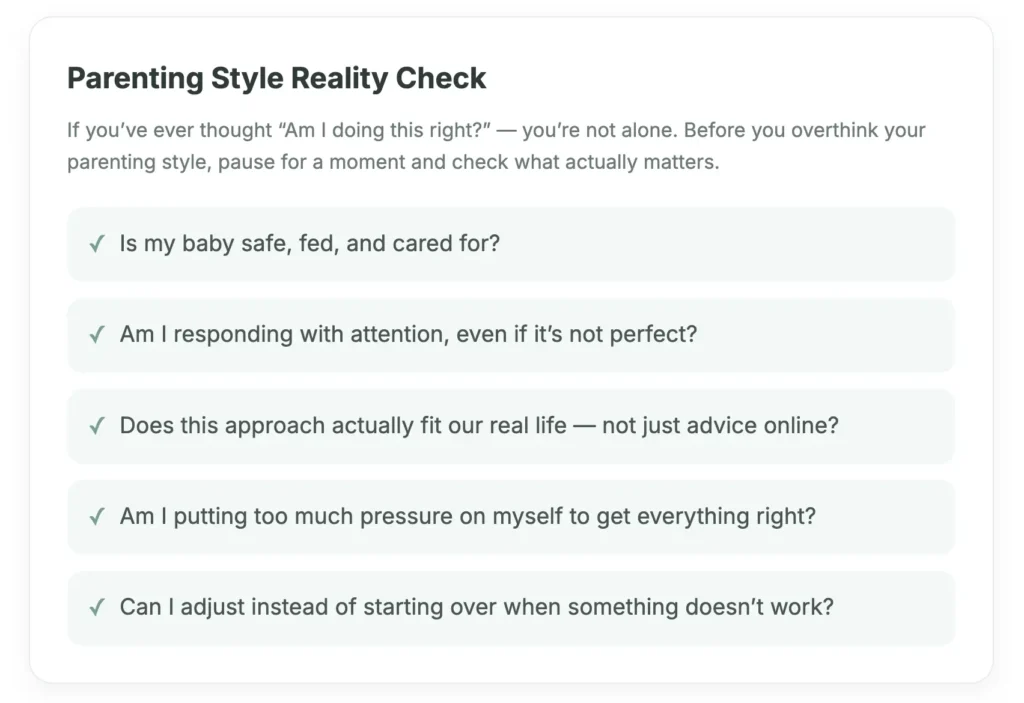
If you saw yourself in more than one example, that is completely normal.
Most parents are a mix.
But usually, one style stands out.
A quick parenting style quiz can help you see your natural pattern in about 60 seconds.
It is not about labeling you.
It is about helping you understand how you make decisions, handle stress, and care for your baby in real life.
Final Thoughts
Parenting style examples are helpful because they make the idea feel real.
Not every parent responds the same way.
Not every family needs the same routine.
Not every baby gear choice has the same “best” answer.
And that is the point.
Your parenting style is not about being perfect.
It is about understanding your natural strengths, noticing your blind spots, and building a parenting life that fits your actual family.
Once you see your style in real-life moments, parenting starts to feel less like a test and more like a rhythm you can grow into.
Suggested Reading
- What Is My Parenting Style?
- The 6 Types of New Parents
- What Type of Parent Are You?
- The Tactical Parent Guide
- The Zen Parent Guide
- Parenting Style Baby Sleep
- Parenting Style Baby Routine
- Best Parenting Style for Newborns
Parenting style examples are not about labels — they are about understanding what works for your real life.